EV Fleet Charging Software
Guide to EV Fleet Charging Software
Managing an EV fleet involves managing energy costs that shift hourly, grid connections that constrain how much power you can draw at any given time, departure schedules that leave no room for error, and charger infrastructure that can fail if not properly monitored. Without proper coordination, the result can be missed departures, contract penalties, spiralling energy bills, and battery capacity loss that increases fleet cost of ownership.
This in-depth guide covers what EV fleet charging software actually does, where basic tools fall short, how to evaluate the right solution, and what a well-managed charging operation looks like in practice, including the financial impact operators can realistically expect.
30%
Typical reduction in energy costs
6-9 month
Typical ROI payback period
2–5 year
Battery life extension per bus
€17k
Monthly savings per 100 buses
DEFINITION
What is EV Fleet Charging Software?
EV fleet charging software, also known as a Charge Management System (CMS), is the layer of intelligence that sits between your vehicles, chargers, and energy supply. It coordinates when and how each vehicle charges based on operational priorities, energy availability, grid limits, and cost.
EV Charging Management Software is not the same as the basic software that comes with your chargers. Charger-native tools are built to track charger uptime and log faults. They are useful in the early stages of electrification, but they cannot plan charging across a fleet, manage grid demand, respond to tariff changes, or check that every vehicle is ready for service at departure. As fleets grow, those limitations become an operational risk.
A proper EV fleet charging management system connects three things that basic tools treat separately: the vehicles (state of charge, route requirements, battery health), the chargers (availability, performance, faults), and the energy supply (grid capacity, tariff windows, peak demand charges). When these are coordinated in real time, your EV charging operation is managed, optimised, and measurable.
The Operational Reality
When Does Charging Become the Bottleneck?
Most operators underestimate how much electrification changes the operational cost structure of running a fleet. With diesel, fuel is a commodity you purchase as needed. With electricity, energy becomes a primary ongoing expense and is highly impacted by how and when you consume it. Here are the most important things to consider:
Grid capacity is a strict limit
Your depot’s grid connection can only handle so much power. Adding more buses and chargers raises the risk of going over that limit. If you overload the grid, you can face penalties from the network operator and sometimes costly upgrades that take months and cost hundreds of thousands of euros.
Peak demand charges can exceed energy costs
Many tariffs charge not only for energy used but also for the highest power demand during the billing period. Just one hour when too many buses charge at once can raise your whole month’s bill. Peak demand charges often make up 20–30% of total energy costs at large depots.
One failed charging session can cancel morning service
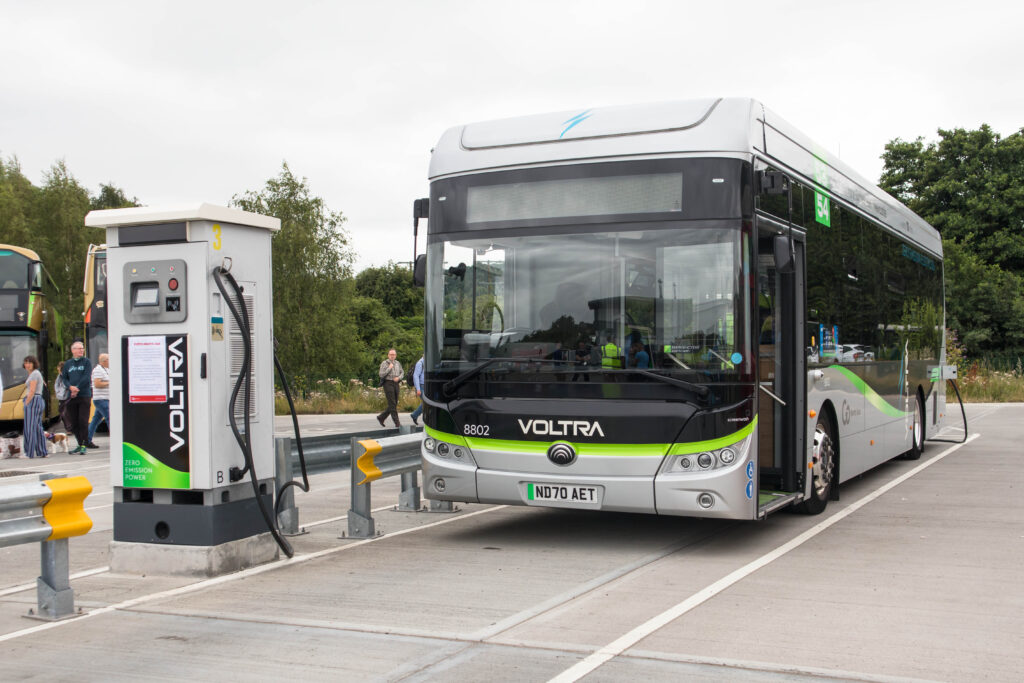
If a charger stops working overnight, it often goes unnoticed until a driver finds an uncharged bus at 5am. The choices are then limited: cancel the route, borrow a bus from another depot, or send out a partially charged bus. Each option costs money.
Battery wear is hard to see until it gets costly
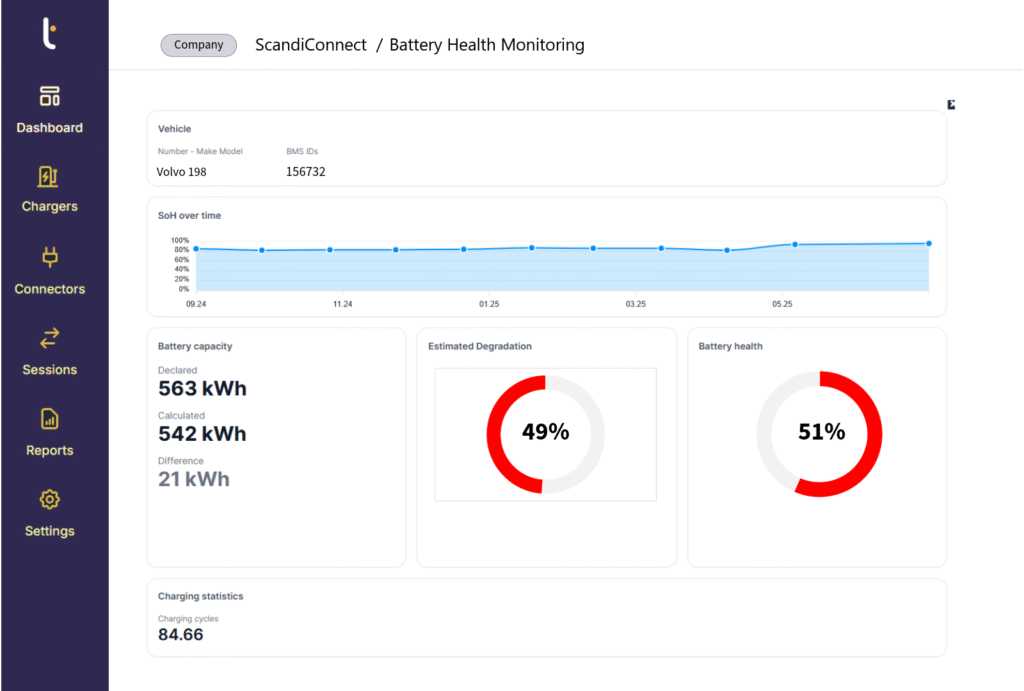
Fast charging often, keeping batteries fully charged for long periods, and topping up to 100% when not needed all speed up battery damage. Replacing an electric bus battery costs €80,000–€120,000. Losing two years of battery life on a 100-bus fleet could cost millions.
In a 100-bus depot, inefficient charging can add €10,000–€15,000 in avoidable monthly costs before any software optimisation is applied.
Limitations
Where Basic Charger Software Falls Short
Basic charger software serves a purpose. For a small fleet operating a single depot with simple overnight charging needs, it may be sufficient. The problem is that most fleets outgrow it faster than they expect.
The main problem is that charger-native tools focus on the hardware. They show what the charger is doing, not what the fleet needs. They can’t answer the key question for depot managers: will every bus be ready for its first departure tomorrow morning?
Without a system that connects vehicle schedules to charging plans, depot teams end up managing this manually. That means checking state of charge across multiple charger portals, making judgment calls about which vehicles to prioritise, and responding reactively when something goes wrong. At scale, this consumes 1–2 hours of staff time per day and still produces worse outcomes than automated coordination.
There is also a cost visibility problem. Energy waste, underused capacity, and suboptimal charging timing often go entirely unnoticed because there is no system to surface them. Operators find out about these losses only when they appear on the energy bill, by which point the money is already spent.
Core Capabilities
What EV Charging Management Software Does
A dedicated EV charging management platform addresses the coordination problem that basic tools cannot solve. Here is what that looks like in practice across the core operational areas.
Smart Charging Optimisation and Scheduling
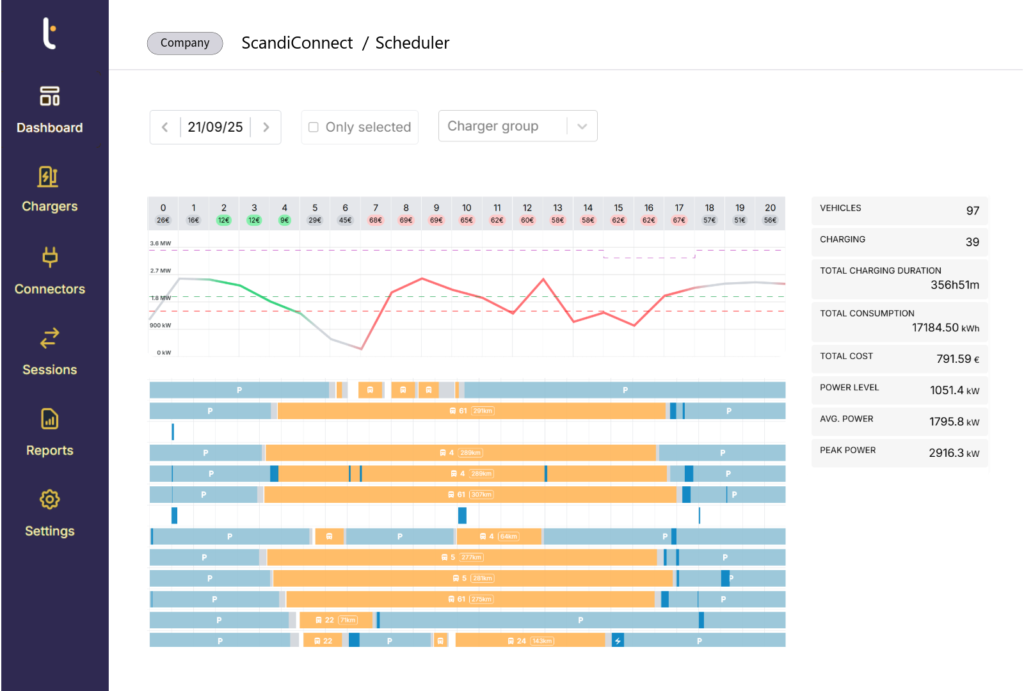
Instead of charging every vehicle to 100% right away, a CMS schedules charging based on what each vehicle really needs. If a bus has a short route tomorrow, it doesn’t need a full charge tonight. If energy prices fall at 2am, the system moves charging to that time. If the grid nears its limit, the system slows charging for lower-priority vehicles while making sure early departures are ready.
Charging only as much as needed for the next trip also reduces battery wear. Keeping batteries between 20% and 80% charge slows degradation significantly, adding 2 to 5 more years of battery life, worth €80,000–€120,000 per bus over its lifetime.
Load Management and Peak Shaving
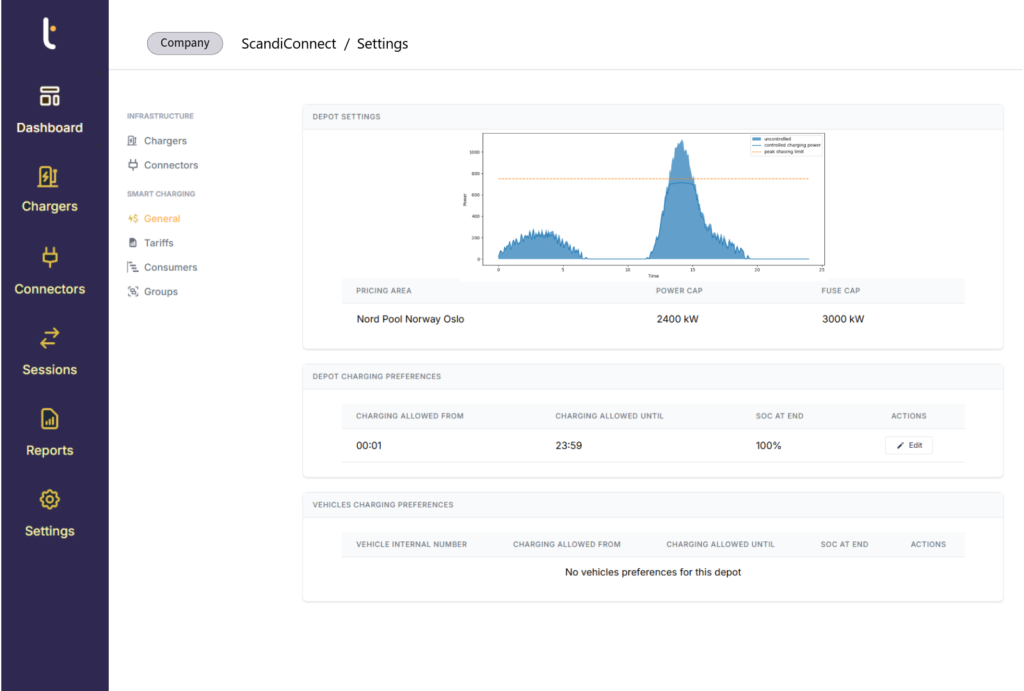
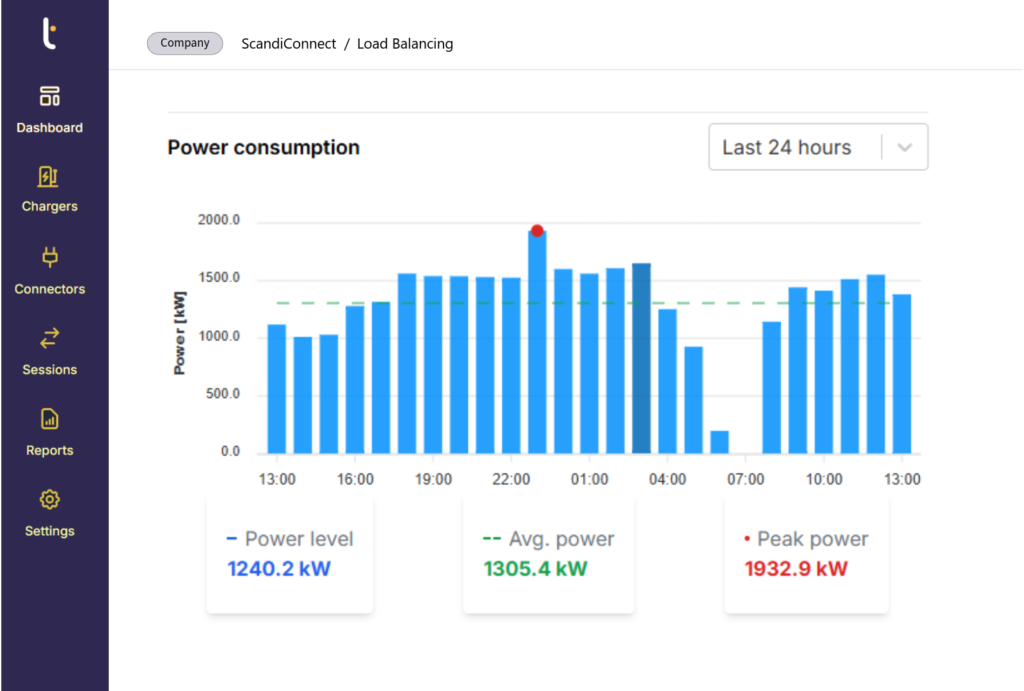
Load management stops the depot from going over its grid limit. When many buses arrive at once after the evening peak, the system spreads out charging instead of letting all chargers draw full power at the same time.
Peak shaving takes it further: the system avoids demand spikes that raise the monthly bill. Reducing peak use by 20% usually cuts the energy bill by 10–15%, depending on tariffs. For a 100-bus depot, smart load balancing and off-peak charging can lower peak charges by 15–25%, saving about €2,000 a month on that cost alone.
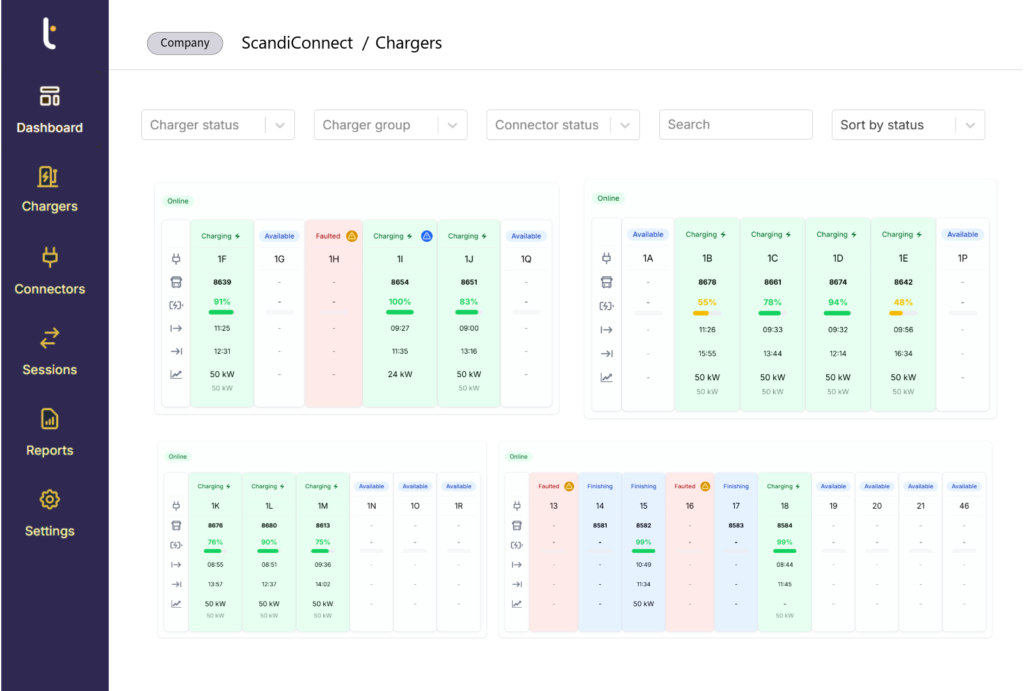
Real-Time Charger Monitoring and Diagnostics
Knowing that a charger has failed is only useful if you know before it affects service. A CMS continuously monitors every charger-vehicle connection and raises alerts when a session stops unexpectedly, charging is slower than expected, or a fault pattern suggests an imminent hardware issue.
Instead of discovering a problem at 5am when a driver reports an uncharged bus, depot teams can act the night before. Avoiding just 4–6 missed routes per month can save €1,000–€2,000 in direct penalties, and the indirect cost of protecting tender competitiveness is harder to quantify but often more significant.
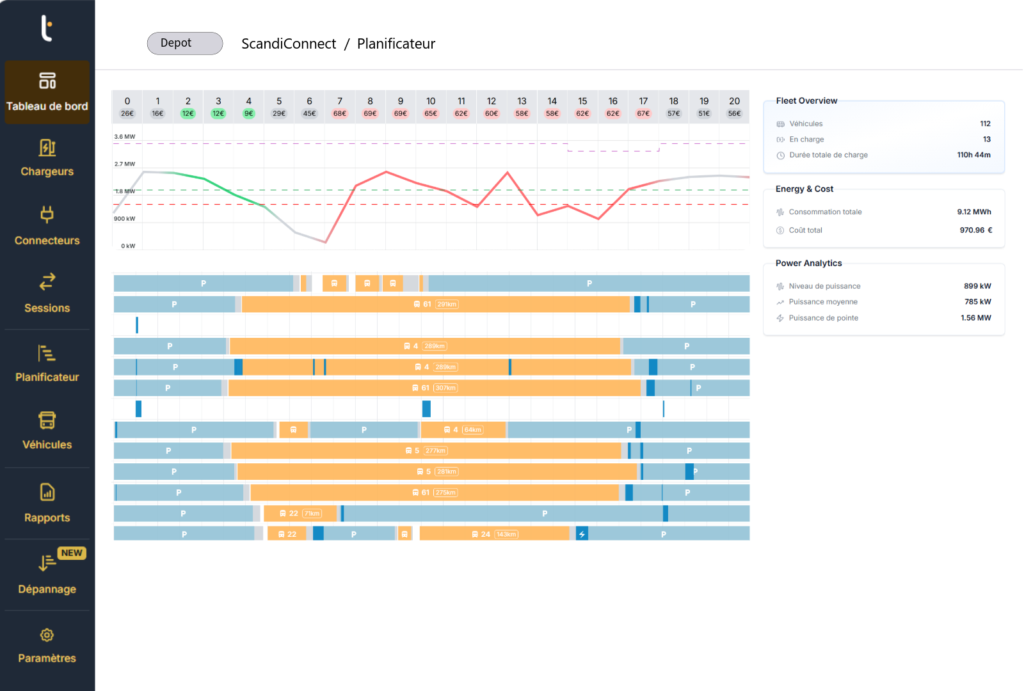
Vehicle-Focused Charging Coordination
The distinguishing feature of purpose-built EV fleet charging software is the ability to integrate charging with fleet operations. This means connecting to scheduling systems such as IVU, Hastus, and Trapeze to understand which vehicle is doing which route, at what time, and from which depot.
With that context, the charging plan is based on the actual operational picture: vehicle A needs 280 kWh by 6:15am for a long intercity route; vehicle B only needs 120 kWh by 8:00am for a short urban loop. The system allocates charging capacity accordingly, prioritising operational readiness over arbitrary charging order.
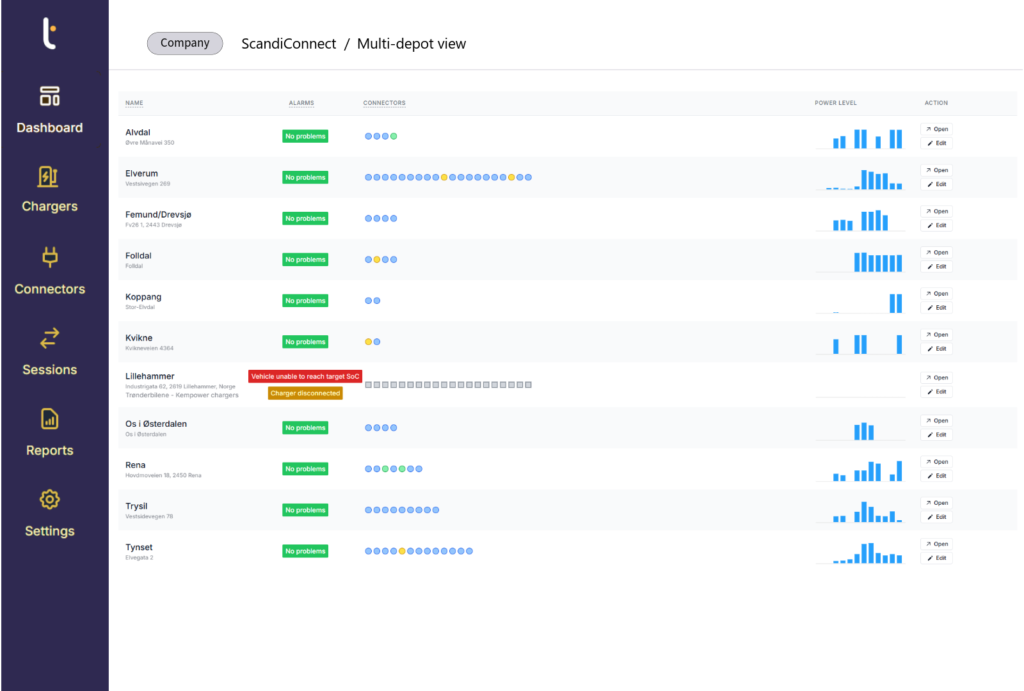
Multi-Depot and Infrastructure Management
For operators with multiple depots, coordination gets even harder. Energy costs, grid limits, and tariffs vary by location. Vehicles move between depots, and some infrastructure might be shared with other operators or third parties.
A fleet-level charging platform provides a unified view across all depots, making it possible to balance energy usage across locations, manage shared infrastructure access securely, and identify where spare capacity exists that could be monetised.

See Tenix Charge in Action
Watch how Connect Bus, a leading bus operator uses Tenix Charge Management Software to reduce costs, manage grid constraints, and ensure every bus is ready for departure.
Watch Video/
Business Case
The Financial Case: What Operators Actually Save
The business case for EV charging management software is the sum of several distinct saving streams that compound across a fleet’s lifetime.
€13–17k
Monthly savings per 100 buses
6–9 months
Typical full ROI payback
€12M
Potential lifecycle saving, 100-bus fleet
30%
Typical energy cost reduction
| Saving Category | Mechanism | Monthly Impact (100 buses) |
|---|---|---|
| Peak demand reduction | Load balancing and off-peak scheduling cut peak charges 15–25% | ~€2,000 |
| Dynamic price optimisation | Charging aligned to low-price tariff windows | €6,000–€7,500 |
| SoC optimisation | Charging only to route requirements, avoiding unnecessary top-ups | €3,500–€3,700 |
| Penalty avoidance | Proactive fault detection prevents missed departures | €1,000–€2,000 |
| Flexibility and depot sharing | Spare daytime capacity monetised via grid services or third-party access | €800–€1,600 |
| Total | €13,000–€17,000/month |
Return on Investment
At this level, payback for a well-scoped CMS implementation typically falls within 6 to 9 months.
The long-term benefits are larger still. Optimised charging that adds 2 to 5 years to battery life saves €80,000–€120,000 per bus. For a 100-bus fleet, that means up to €12 million saved in replacement costs over the vehicles’ lifetimes. Operators with better reliability might also need 2 to 4 fewer standby vehicles, saving another €1.5–3 million.
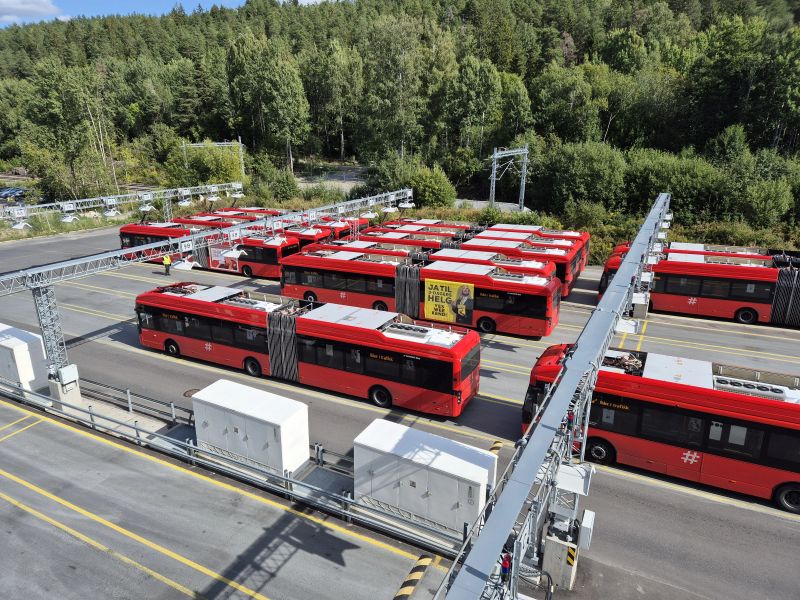
Electric Bus and Public Transport
EV Charging Software: Specific Considerations for Bus Fleets
Electric buses and public transport fleets represent the most demanding charging environment in the industry. The constraints are stricter and the consequences of failure more immediate than in almost any other fleet context.
Fixed timetables leave no room for delays
Electric buses and public transport fleets represent the most demanding charging environment in the industry. The constraints are stricter and the consequences of failure more immediate than in almost any other fleet context.
Depot capacity is limited by design
Public transport depots are built for a certain fleet size. Adding more chargers doesn’t always mean more grid power. Operators often discover that reaching 80–90% electrification requires smart load management to stay within current grid limits otherwise they face expensive and slow upgrades.
Battery warranty and lifecycle management are important
Bus manufacturers set charging protocols to protect warranty conditions. A CMS that tracks each vehicle’s charging history, respects charge limits, and avoids aggressive charging patterns protects warranty validity and resale value as well as operational performance.
Charging reliability is part of the contract
Transport authority contracts increasingly include KPIs around service availability and reliability. The ability to demonstrate charging reliability data, show fault response times, and report year-on-year improvement is becoming a requirement in tender documentation.
Buyer’s Guide
How to Evaluate EV Fleet Charging Software
When assessing solutions, the most important distinction to draw is between charger management tools and fleet charging management platforms. The former is built around the hardware; the latter is built around operations. Here are some questions worth asking during the process of evaluating an EV fleet charging software:
Does the software connect with your scheduling system?
If the charge management software can’t access your route and timetable data, it’s optimising charging without context. Charging plans should come from actual operational needs, not generic rules.
How does the software manage grid limits?
Some systems just cap total power use; others shift load based on which vehicles leave first. Find out what happens if the depot nears its grid limit and a high-priority bus still needs charging.
How does fault detection work?
Ask to see how the system reacts if a charger stops mid-session at 2am. How fast is the alert? Who gets notified? What details help the depot team fix the problem?
Is the softwarehardware-agnostic?
Fleets with chargers from different brands need software that isn’t tied to one ecosystem. OCPP compliance is the baseline; make sure you understand what that means for your chargers.
Is the software scalable across depots?
Separate tools at each depot cause reporting gaps and prevent multi-depot optimisation. If you run or plan to run multiple sites, managing everything from one platform important.
Does the software support flexibility market participation?
Depots with extra daytime capacity can join grid flexibility programmes and sell reduced demand back to the network operator. 1 MW of spare capacity used 80 hours a month can earn €1,000–€3,000 extra each month.
Decision Framework
When Does a CMS Make Sense?
A Charge Management System becomes the right investment when the complexity of the operation exceeds what manual coordination and basic tools can reliably handle.
The threshold is typically reached when one or more of the following apply:
- You operate more than 30 electric vehicles
- You manage multiple depots or plan to
- Your operation runs with more than one brand of charger
- Your grid connection is under pressure as the fleet grows
- Energy costs are a significant or unpredictable
- Charging failures have affected service delivery
- You are preparing for a tender where reliability data will be scrutinised

About Tenix
EV Fleet Charging Software Built for Operations
Tenix was created specifically for the needs of electric bus and public transport fleets, built with input from operators like Vy Buss and Connect Bus in the Nordics, in environments where uptime and punctuality directly affect contract performance.
The platform manages energy use, charging schedules, and grid capacity in one system. It connects with scheduling platforms including IVU, Hastus, and Trapeze, so charging plans come from real operational needs. It monitors every charger-vehicle connection in real time and raises alerts before faults disrupt departures.
Operators using Tenix EV charging management software typically reduce energy costs by up to 30%, extend battery life by several years, and achieve full return on investment within six to nine months. Tenix works with any charger or vehicle brand, and scales from one depot to multiple sites without vendor lock-in.
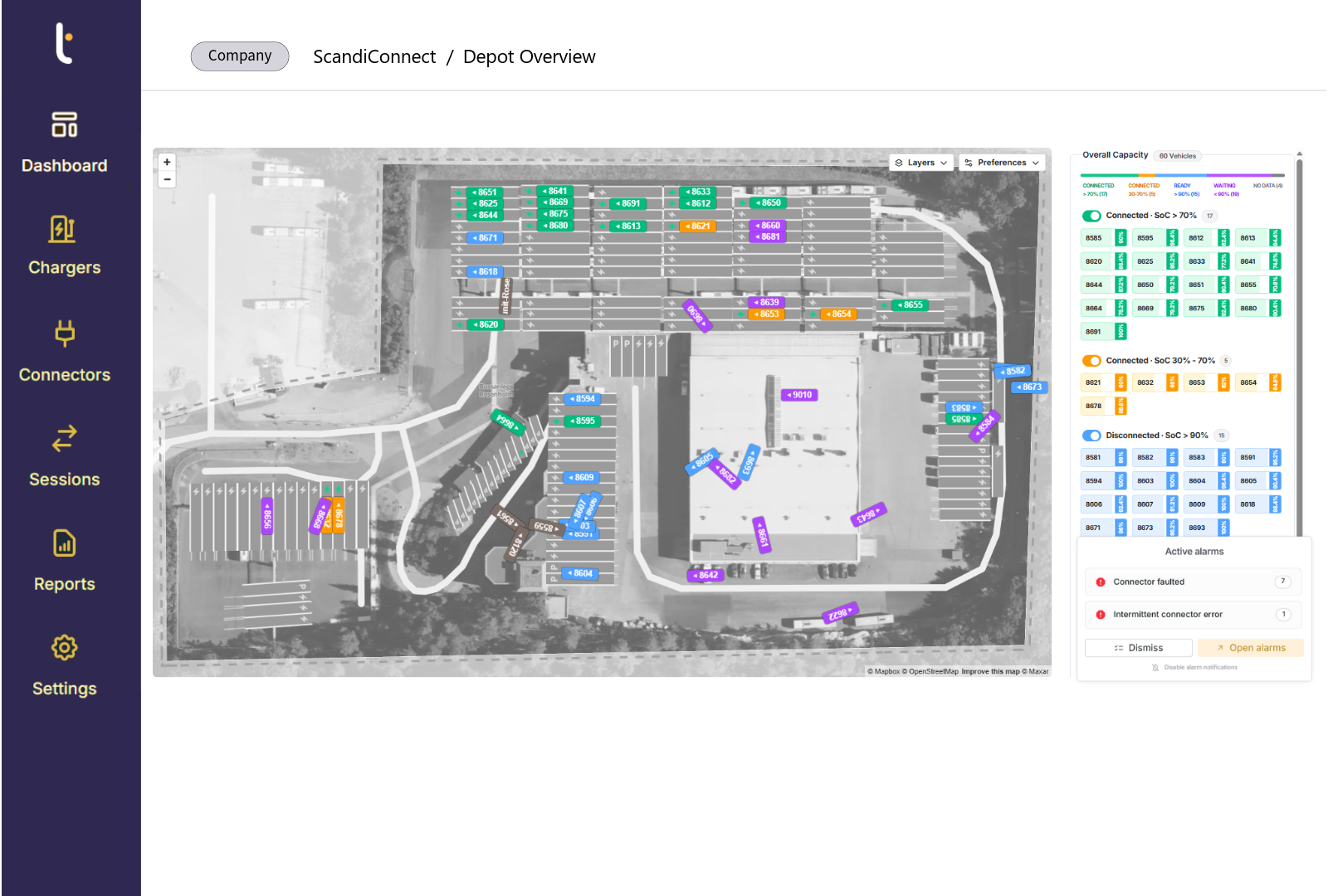
See Tenix in action
Request a demo to see how Tenix supports EV fleet charging at scale — from smart scheduling and load management to real-time diagnostics and multi-depot coordination.
Book a demoOr contact us at sales@tenix.eu · +47 4777 0070
Explore
Further Reading
Customer Interview
Inside Connect Bus Rosenholm: Norway’s Largest
Fully Electric Bus Depot
 English (UK)
  Norsk bokmål
  Français