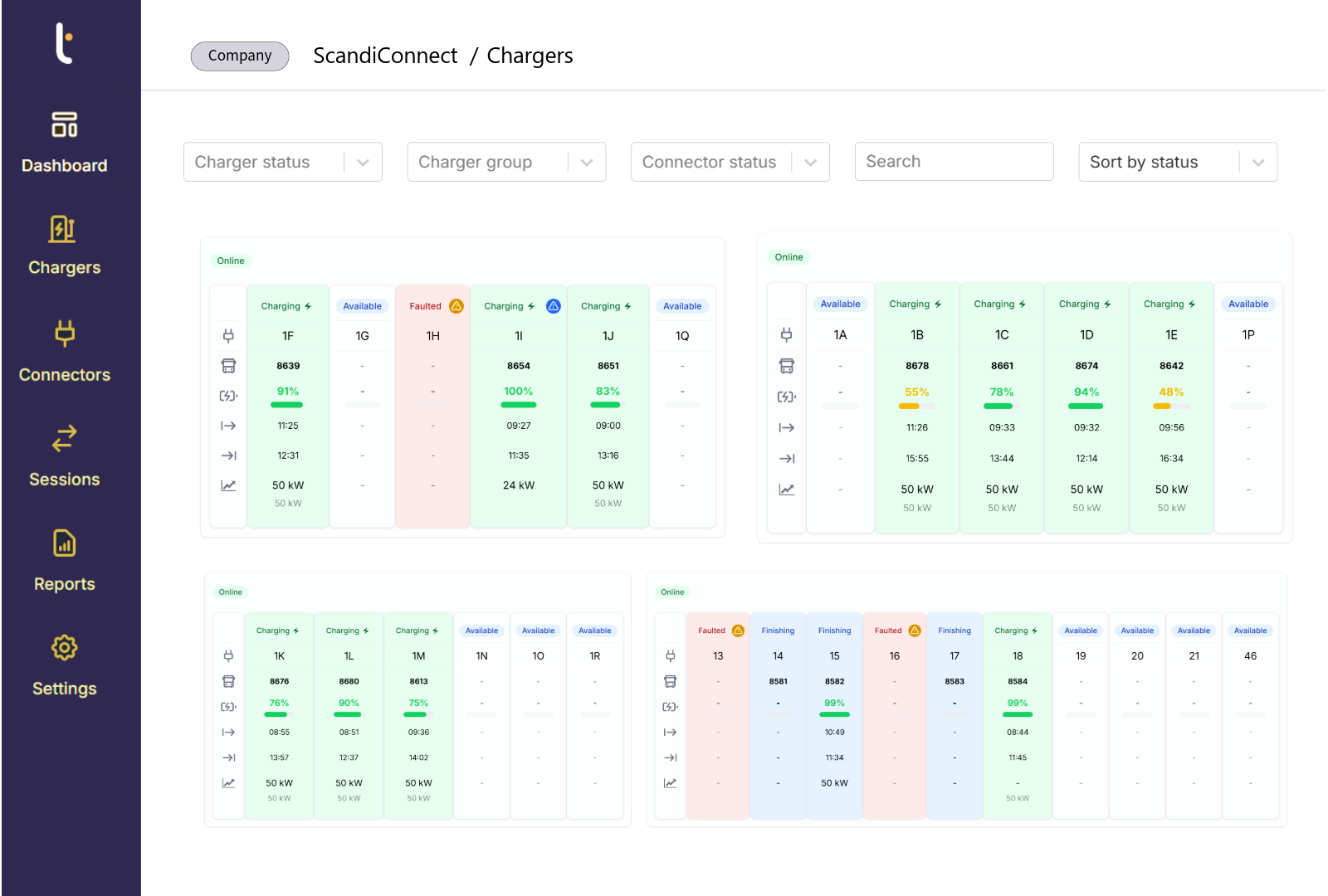
When a charger fails overnight, and no one finds out until a driver reports an uncharged vehicle at 5am, the options are limited: cancel the route, take a vehicle from another allocation and cause further disruption, or send the bus out undercharged and accept the operational risk. Each choice comes with costs: financial penalties, schedule delays, and a service failure record that affects future contracts. Charger monitoring and diagnostics help EV fleets detect faults early, preventing those missed and unbudgeted costs.
Finding a fault at 1am instead of 5am completely changes the options. The vehicle can be moved to a working charger, the route adjusted, or a manual boost started with enough time to avoid a service failure. The fault has still happened, but having time to respond makes all the difference.
This article explains what EV charger monitoring entails, highlights the fault patterns that matter most in fleet charging, and shows how proactive diagnostics improve both operations and fleet economics.
Why Charger Reliability Directly Affects Service Delivery
In low-use settings like workplace charging sites or small depots, charger faults are mostly inconvenient. But there are usually spare chargers available, vehicles don’t follow strict schedules, and a failed overnight session can be restarted without causing too much problem.
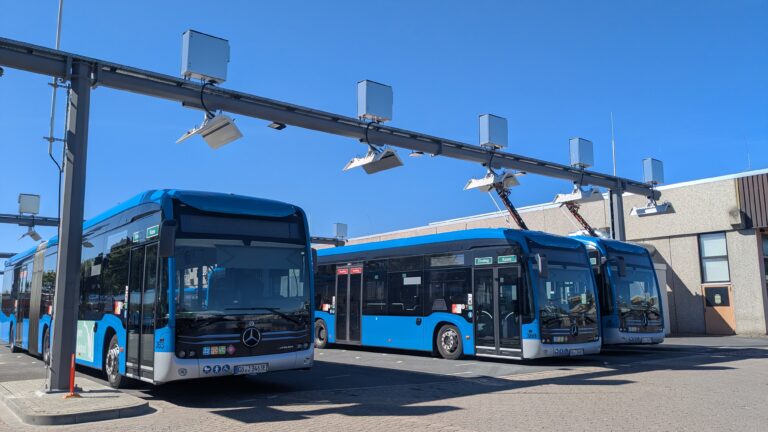
Electric bus and commercial fleet depots operate under very different conditions. Chargers run heavily every night, vehicles have fixed departure times, and there are rarely enough spare vehicles to absorb a missed charge without disrupting service. In this environment, one undetected charger fault can cancel a route, trigger contract penalties, and leave a service failure record that affects future tenders.
Charger reliability directly affects service delivery in a fleet depot. Managing problems reactively, after they have disrupted operations, carries costs that compound with fleet size.
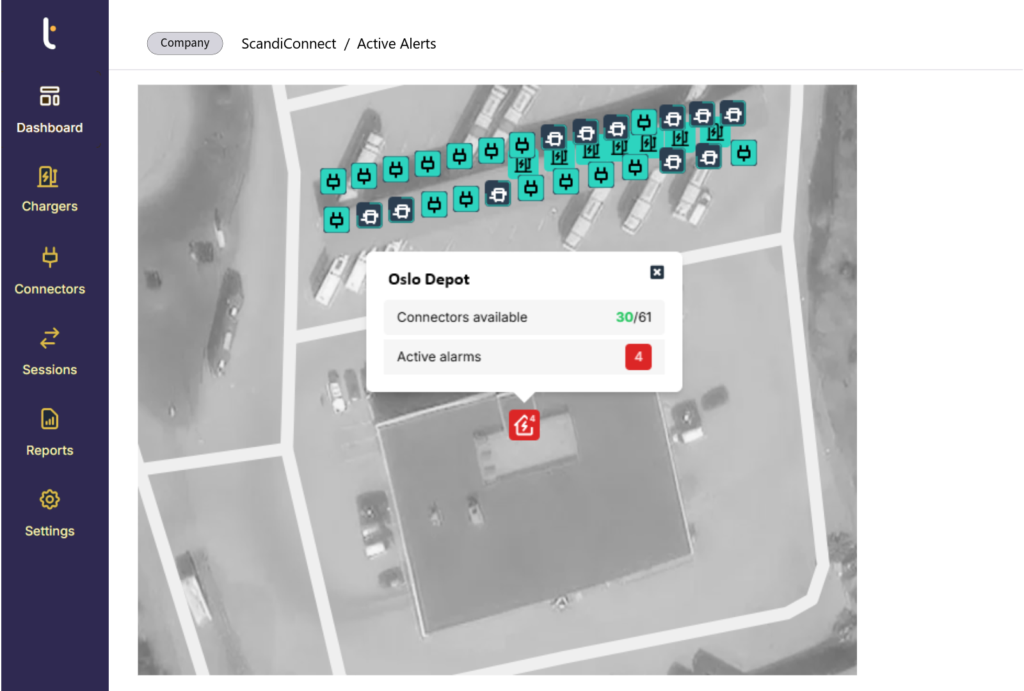
What EV Charger Monitoring Involves
In a fleet context, charger monitoring goes beyond tracking whether a charger is on or offline. The operational questions that matter are more granular: Is this charging session proceeding at the expected rate? Is the charger-vehicle connection stable? Will this vehicle reach its required state of charge before its departure window opens?
Answering those questions requires continuous monitoring of individual charging sessions, not just charger status. A session that is technically active but charging at 30% of its expected rate is operationally different from one performing normally. Without session-level monitoring, that distinction is invisible until the vehicle is checked at departure.
The data points that matter in real-time charger diagnostics include charging power output, state-of-charge progression over time, charger-vehicle communication status, error codes and fault flags, and session duration relative to departure requirements. Each is a technical metric, but together they indicate whether the charging operation is on track to deliver the fleet readiness required the following morning.
The Fault Patterns That Create the Highest Operational Risk
Not all charger faults carry equal operational risk. The ones that matter most in a fleet context share the fact that they are not immediately visible, and their consequences are not felt until departure time.
Undetected session failures are the highest-risk category. The charger appears connected and active in basic monitoring views, but the charging session has stopped or is delivering less power than expected. Without session-level monitoring, these faults can run undetected for hours—long enough for a vehicle to arrive at departure significantly undercharged.
Intermittent communication faults between charger and vehicle cause sessions to pause, restart, or operate at reduced power without generating an obvious error state. They are difficult to diagnose from static charger status data and often only become apparent through analysis of session-level power progression over time.
Thermal and hardware degradation faults develop gradually. A charger approaching a hardware failure may still complete sessions but at reduced efficiency and with increasing frequency of minor errors. Identifying these patterns before they produce a full session failure requires trend analysis across charging history, not point-in-time status checks.
Connectivity faults between the charge management system and individual chargers mean that session data stops being reported, creating a blind spot in operational visibility. The charger may be functioning normally, or it may have failed without the data connection, neither is knowable.
Each fault type requires a different detection approach. Silent session failures require session-level power monitoring. Intermittent faults require pattern recognition across multiple sessions. Hardware degradation requires trend analysis over time. Connectivity faults require monitoring of the monitoring itself and detecting the absence of data as a signal in its own right.
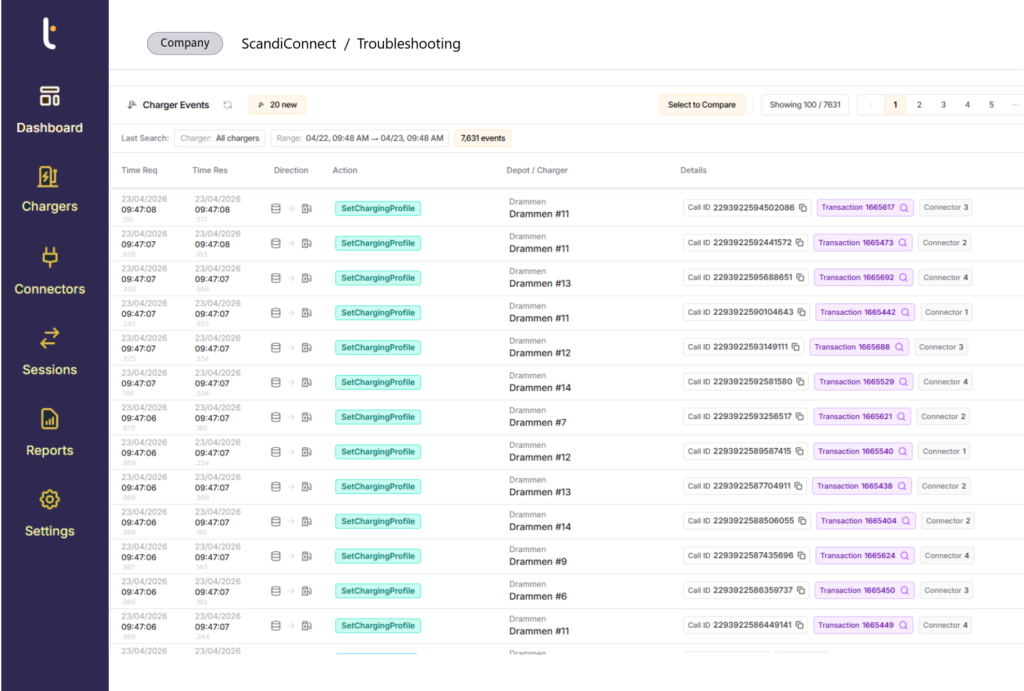
From Reactive to Proactive: What Good Monitoring Enables
The operational value of real-time charger monitoring is creating enough lead time to act before a fault becomes a service failure.
A fault detected during the overnight charging window, even in the early hours, gives the depot team options. A vehicle can be moved to a functioning charger, a route allocation adjusted, or a manual boost charge initiated for a critical departure. The problem is the same size regardless of when it is detected. The response options are entirely different.
Alert quality matters as much as coverage. An alert raised at 1:05am when a session stops unexpectedly is operationally valuable. An alert raised at 4:55am when a vehicle is projected to miss its required state of charge by departure time is nearly useless, there is no longer enough time to act meaningfully. Effective monitoring raises the right alerts at the right time, with enough context for the depot team to understand immediately what the problem is and what they can do about it.
Alert fatigue is the practical risk on the other side. A system that generates high volumes of low-priority notifications trains depot staff to deprioritise alerts, with the result that critical ones are missed. Effective diagnostics filter signal from noise, surfacing only the alerts that require action and providing enough operational context to make that action straightforward.
Monitoring Chargers of Different Brands
Most electric fleet depots carry multiple brands and models of charger. Hardware has been added incrementally as fleets have grown, procurement decisions have varied across contracts, and different depots within the same operation may run entirely different charger brands. Without a hardware-agnostic monitoring layer, operators must use multiple manufacturer portals to maintain visibility across their infrastructure.
A fault on a charger brand whose portal the depot team checks less frequently may go undetected for longer than one on a more familiar system. And the cross-charger analysis that would reveal fleet-level patterns such as fault rates by brand, performance trends across depots is impossible when data lives in separate systems.
Hardware-agnostic charger monitoring, operating over OCPP and integrating data from all charger brands into a single view, eliminates those blind spots and enables the cross-fleet analysis that supports both operational decisions and longer-term infrastructure planning.
Tenix: Real-Time Charger Monitoring and Diagnostics
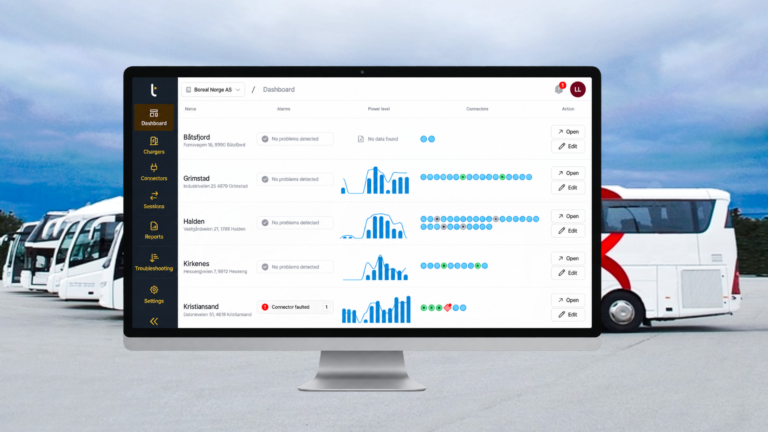
Tenix monitors every charger-vehicle connection in real time, tracking session-level performance against each vehicle’s departure requirements. Alerts are raised when sessions stop unexpectedly, when a vehicle is not going to reach its state of charge, or when charger behaviour suggests a hardware issue. All with enough lead time for depot teams to act before departures are affected.
The platform works across any charger brand via OCPP, providing a unified view of charging infrastructure across all depots from a single interface. Historical fault data and session performance trends support both predictive maintenance planning and infrastructure investment decisions.
Charger monitoring in Tenix operates as part of the broader charging operations platform alongside smart charging schedules, load management, and SoC prioritisation so reliability data is always interpreted in the context of operational requirements, not in isolation.
Full details of Tenix’s charging operations capabilities, including real-time monitoring and diagnostics, are available on the Tenix Charge Solution page.

 English (UK)
  Norsk bokmål
  Français