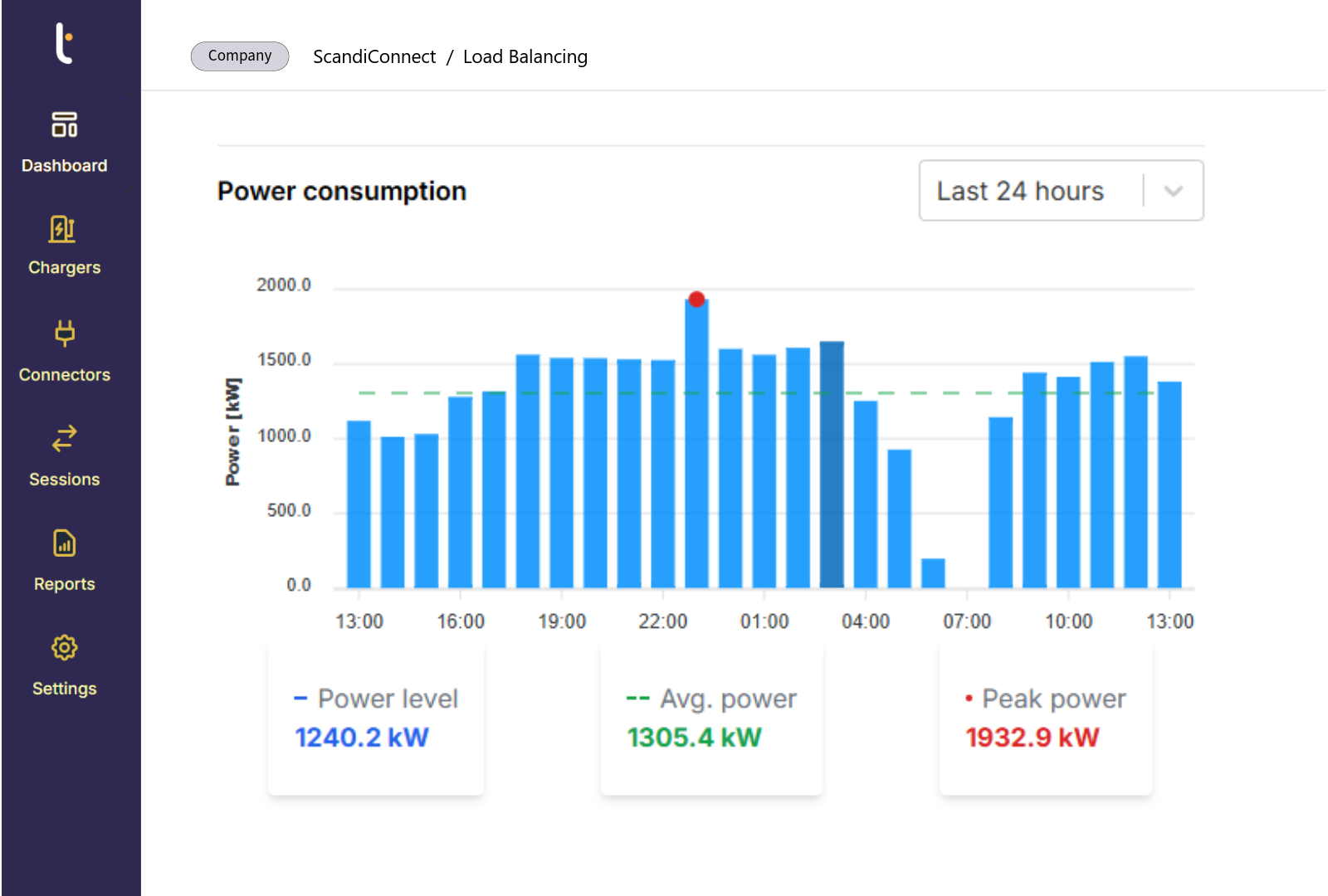
At large bus depots, peak demand charges can account for 20 to 30 percent of the total energy bill, and that cost can be set by a single bad hour of charging, not by ongoing electricity use. This article explains why that happens and how to reduce the cost of peak charges.
What Are Peak Demand Charges, and How Are They Calculated?
Many commercial energy tariffs across Europe don’t just charge for how much power you use. They also charge for the highest amount of power you draw at any point in the billing period, usually measured over a 15 or 30-minute window.
That means the tariff isn’t based on your average consumption, but on your highest draw. If forty buses plug in at once and the depot spikes to 6 MW for half an hour, that spike becomes the basis for demand charges across the entire month, even if the depot runs well below that level the rest of the time.
This is why one poorly managed overnight charging session can push up a depot’s monthly bill significantly. The goal is to avoid that spike in order to lower overall monthly costs.
Why Fleet Charging Naturally Creates Demand Spikes
Electric bus depots aren’t like office car parks with charging spread throughout the day. Buses return in fixed windows dictated by the timetable, typically one to two hours after evening peak service. When forty, sixty, or a hundred vehicles arrive in that window and start charging, combined demand can reach two to three times what the grid connection actually supports.
A depot with a 3 MW grid connection might have chargers capable of drawing 6 to 8 MW because depots install enough charging points to serve the whole fleet in a short overnight window. The total charger capacity is built well above the grid connection by design. The real constraint is timing: fixed schedules mean buses arrive together, and arriving together means demanding power at the same time.
Without coordination, this concentrated demand does two things: it risks tripping grid limits or triggering automatic charger power reduction, and it sets a peak that the tariff will be based on all month.
The Assumed Fixes That Won’t Work
When a depot hits its power ceiling, the natural response is to add capacity. More chargers, stronger chargers, or even a grid upgrade. None of these fix the underlying problem.
More chargers don’t increase the power available from the grid. If the connection delivers 3 MW, adding chargers just adds more equipment competing for the same 3 MW.
Higher-power chargers speed up individual sessions but make the peak worse. Swap 50 kW chargers for 150 kW chargers with no change in coordination, and the depot hits its grid ceiling faster, not slower.
Grid upgrades are the right long-term answer for depots that genuinely need more capacity, but they take 12 to 24 months and cost hundreds of thousands of euros. They don’t help with next month’s bill, and in some locations, network constraints mean an upgrade isn’t available at any price.
High peak charges do not indicate that the depot has too few chargers or too little power. It means nobody is actively deciding how the power that’s already there gets shared out.
Load Balancing vs. Peak Shaving
These two terms get used interchangeably, but they solve different problems and it’s worth being precise.
Lastbalansering keeps total charging demand within the grid connection’s limit, moment to moment. It works by dynamically adjusting power across active sessions, lowering or pausing lower-priority charging to free up capacity for vehicles that need it more urgently. Without load balancing, a depot either exceeds its grid limit or chargers cut power on their own, with no guarantee the right vehicles get protected.
Toppbarbering manages the cost consequence of demand spikes. It caps total charging power against defined thresholds so the highest 15 or 30-minute reading in the billing period stays as low as possible, since that reading is what the tariff bills against.
Both rely on the same underlying capability: real-time visibility into every charger and vehicle, an understanding of which vehicles actually need power first, and the ability to redistribute that power continuously. And for public transport, both have to happen without compromising vehicle readiness. A cheaper energy bill doesn’t help if a bus leaves the depot half-charged.
Core Strategies to Reduce Peak Demand Charges
Dynamic load allocation. Instead of giving each charger a fixed power level, available capacity is distributed across active sessions and reallocated continuously as vehicles finish or slow down. The depot sits at or near its grid ceiling steadily, rather than spiking during arrival windows and idling the rest of the time.
Fleet-based prioritisation. Charging order should follow operational need, not arrival order. A bus leaving at 5:30am on a long intercity route needs a full charge tonight. A bus on a short urban loop leaving at 9am can wait. A vehicle already at 80 percent might not need to charge at all. This only works if the system understands route requirements and departure times, not just plug-in time.
Time-based optimisation. Shift charging toward hours when the grid has the most headroom and energy costs less. Depot power availability changes overnight depending on lighting, heating, and maintenance load, and energy prices vary hour to hour. For a 100-bus depot, shifting to off-peak hours typically cuts energy costs by 10 to 15 percent on its own.
Continuous real-time adjustment. Charging plans built at 10pm don’t survive the night unchanged. Vehicles arrive late, chargers fault, schedules shift. Whatever manages this needs to reprioritise, reallocate power, and raise alerts without someone stepping in every time something changes.
How Peak Shaving Works in Practice
In practice, peak shaving means setting a power ceiling, either fixed or scheduled to match tariff structures, and having the system hold total charging demand under it automatically.
That typically looks like:
- Depot-level peak limits. A maximum power threshold for total charging demand across the site.
- Group-level power caps. Limits applied by time of day, matched to the tariff’s own peak and off-peak windows.
- Integration with charging plans and priorities. Peak limits work alongside, not instead of, the prioritisation logic deciding which vehicles charge first.
- Automatic enforcement. Power allocation recalculates in real time as conditions change, so the depot stays inside its limit without manual adjustment.
Done well, this is invisible to depot staff day to day. The system holds the ceiling; nobody has to watch a dashboard and manually throttle chargers at 11pm.
The Business Case: What Fleets Actually Save
The numbers are consistent across depots that move from uncoordinated to actively managed charging:
- 10 to 15 percent energy cost reduction from off-peak charging alone
- 15 to 25 percent peak charge reduction from smart load balancing
- €8,000 to €10,000 combined monthly savings per 100 buses
- Grid upgrades that looked urgent at 60 percent electrification can often be deferred to 85 to 90 percent, avoiding significant capital spend in the meantime
That last point matters for planning as much as for the monthly bill. Coordinated charging doesn’t just reduce cost, it buys time before the next major infrastructure investment is actually necessary.
Download the ebook: The business justification of smart charge management here.
What a Charge Management System Needs for Effective Peak Shaving
Not every charge management system can do this well. To reduce peak demand charges specifically, rather than just schedule charging, a system needs to:
- Measure total depot demand in real time, not just individual charger status
- Enforce a power ceiling automatically, adjusting allocation across sessions as conditions change, not just alert someone when the limit is close
- Apply that ceiling alongside prioritisation logic, so the cap doesn’t just cut power to whichever vehicle happens to be charging
- Support scheduled limits that can be set to match tariff structures, not just a single static threshold
This is what separates a system that can prevent a demand spike from one that can only report on it after the fact.
Bottom Line
A single uncoordinated hour of charging can define the cost of an entire billing period, regardless of how efficiently the rest of the depot runs. That’s what makes this different from a typical energy-saving problem: the target isn’t to reduce total consumption, it’s to alter the shape of the demand curve.
Load balancing, prioritisation, and peak shaving all work on that shape directly, holding the depot’s demand steady instead of letting it spike when the fleet arrives. Done well, this happens automatically, night after night, without depot staff having to monitor a dashboard or make manual calls under pressure.
For fleets already paying peak demand charges, that’s usually the fastest lever available to reduce costs, and one that pays off well before any other investment in the depot does.




 English (UK)
  Norsk bokmål
  Français