BUYER’S GUIDE
Charge Management Software Evaluation Guide for Electric Fleets
The market for charge management solutions is fragmented. This guide explains what a CMS should deliver, maps the four main approaches available, and gives operators a clear framework for evaluation which is the right fit for their operation.
30%
Typisk energikostnadsreduksjon
6–9 måneder
Typisk tilbakebetalingstid for ROI
2–5 år
Batterilevetidsforlengelse per buss
17 000 kr
Månedlig besparelse per 100 busser
DEFINISJON
What is a Charge Management System?
Charge management as a category covers a wide range of software, from basic tools that monitor charger status to operations-focused platforms that coordinate vehicle charging with schedules, energy tariffs, and grid constraints.
The main difference between them is how much of the charging process they actually manage. A tool that monitors charger uptime and logs faults is doing charge management in the narrowest sense. A platform that builds charging plans for each vehicle, manages grid capacity, reduces energy costs, and monitors every session in real time is solving a fundamentally different and more complex problem.
Understanding what your operation needs is the starting point for any evaluation.
CORE CAPABILITIES
What a Charge Management System Needs to do
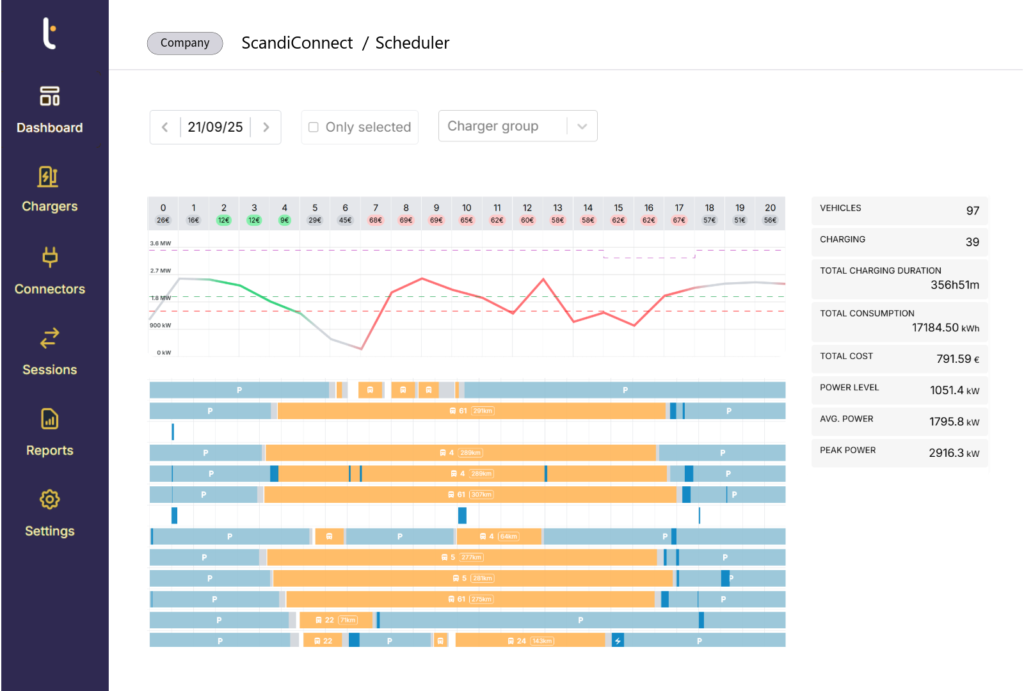
These seven capabilities represent the core functions to assess when evaluating any CMS. Not every operator needs every capability to the same degree, but understanding what each does, and how well each solution delivers it, is the basis for a good evaluation.
Charger monitoring and fault detection
A CMS should monitor sessions, not just charger status. A charger that appears active but delivering low power may go unnoticed until departure.
Load management
Ensures all charging sessions never exceed the depot’s grid limit, while making the best use of available power, across all charger brands.
Peak demand management
Many tariffs charge based on peak power use. A single uncontrolled charging event can set the demand charge for the entire month.
Energy price optimisation
Electricity tariffs vary by hour. A CMS should shift charging load towards lower-cost windows while still ensuring every vehicle meets departure requirements.
Scheduling and prioritisation
Plans charging based on each vehicle’s departure time and route requirements. With electric fleets, charging and vehicle availability must be planned together.
Battery health monitoring and optimisation
State of charge alone doesn’t tell you whether a vehicle can complete a route. Battery degradation matters too, as a bus with 100% charge may still not have the usable capacity required.
Reporting and analytics
Reliability KPIs are increasingly required in tender documentation. Operators need access to their own data, not data filtered through a supplier’s reporting interface.
Market LANDSCAPE
The 4 Main Approaches to Charge Management
The market organises broadly into four categories. Most solutions can be understood through the primary role they play in the charging ecosystem.

Charger Vendor Software
Most charger manufacturers bundle proprietary software with their hardware. This software tracks charging session status, distributes power across connected vehicles, and logs faults. However, it is typically designed around the hardware, not the charging operation.
It typically has no visibility into schedules, route requirements, or departure priorities, so it cannot optimise charging around what the fleet actually needs to do. Because the software is tied to a specific manufacturer, it cannot be used consistently across different charger brands.
BEST SUITED TO
Small, single-depot fleets with a single charger brand, and simple overnight charging requirements
KEY LIMITATIONS
No fleet orchestration, hardware lock-in, limited energy management and no complete operational overview
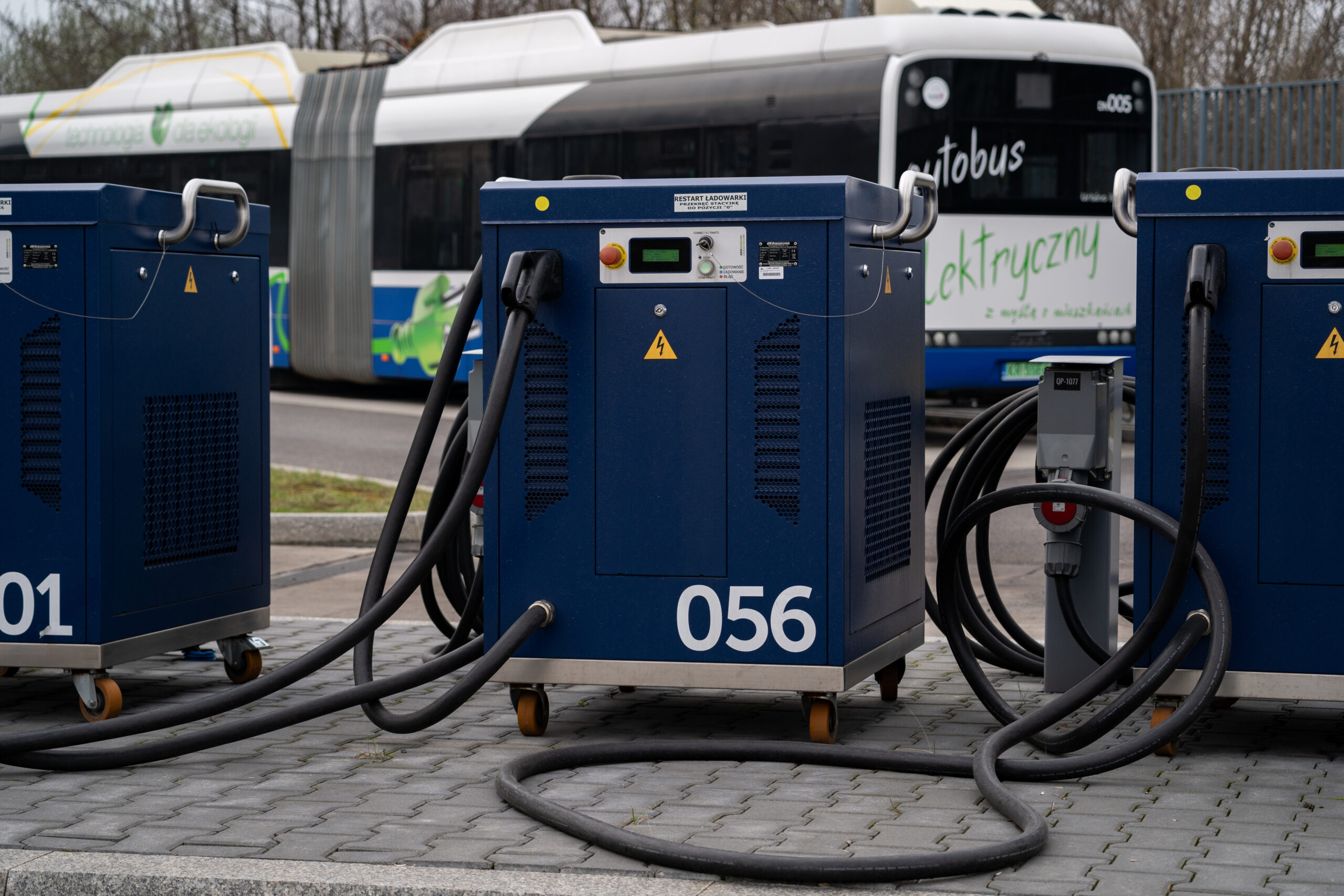
Managed Electrification Services
These providers bundle hardware, software, financing and operational support into a single contract. For operators without in-house charging expertise, a managed service removes complexity and transfers risk to the provider.
Contracts typically run 7 to 10 years. Operators should evaluate the total cost over the full contract period. Managed services often prioritise risk transfer over lowest lifetime cost. Operational control and data access vary significantly between providers and should be carefully assessed.
BEST SUITED TO
Operators willing to outsource decision-making and capital investment at higher long-term cost.
KEY LIMITATIONS
Long-term lock-in, limited flexibility, higher TCO, and reduced ability to adapt as fleet grows.

Route scheduling software with charge management features
Route scheduling platforms manage timetables, vehicle assignments, and driver rosters. Some now include features that consider both vehicle range and charging requirements. The scheduling system holds some of the most important data a CMS needs: route commitments and departure times.
However, charging is typically treated as one input into a scheduling process, not a dedicated operational discipline. Grid and energy optimisation capabilities are often limited, and this approach works best while charging operations remain relatively simple.
BEST SUITED TO
Operators minimising supplier count, with simple charging requirements and limited grid constraints.
KEY LIMITATIONS
If tied to a single scheduling vendor, switching platforms means losing your charge management set-up too.
Purpose-built charge management software
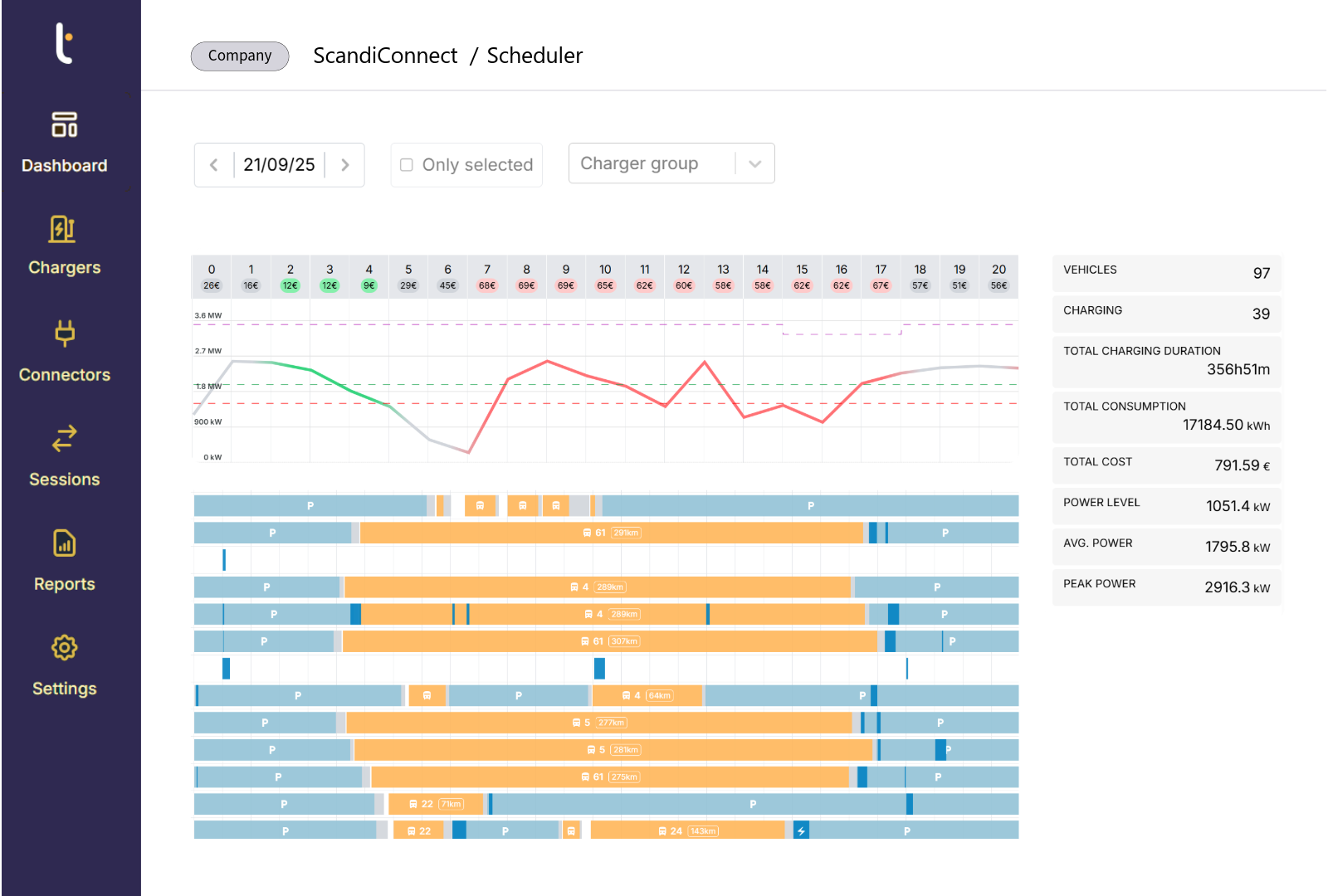
Dedicated charge management software is designed to solve the charge management problem in full. Its sole focus is coordinating vehicle charging within the operational and energy constraints of a fleet depot, with a focus on fleet readiness, instead of charger uptime.
The best systems offer full integration flexibility with fleet scheduling systems, connect to vehicle telematics, and optimise against dynamic energy tariffs. This combination enables full depot charging plans, dynamic load management, energy price optimisation, peak demand reduction, and battery health insights.
BEST SUITED TO
Operators at scale or planning to scale, with complex requirements and mixed charger infrastructure.
KEY LIMITATIONS
The value is proportional to implementation quality. The more data the platform can access, the more it can do.
COMPARISON SUMMARY
How the Four Approaches Compare
| Charger Vendor | Managed service | Scheduling software | Purpose-built CMS | |
|---|---|---|---|---|
| Hardware independence | х | Varies | ✓ | ✓ |
| Scheduling integration | х | Varies | ✓ | ✓ |
| Load management | ✓ | ✓ | Limited | ✓ |
| Energy optimisation | Limited | Varies | Limited | ✓ |
| Battery health tracking | х | х | х | ✓ |
| Operator ownership data | Limited | Limited | ✓ | ✓ |
| Long-term flexibility | Medium | Low | Medium | High |
DECISION FRAMEWORK
How to Choose a CMS
For operators running fewer than 30 electric vehicles at a single depot with a single charger brand, and straightforward overnight charging needs, charger vendor software may be sufficient.
For operators running at scale, a purpose-built CMS is the approach that delivers full operational control without the long-term cost burden of managed services or the operational gaps of bundled solutions.
Indicators that a dedicated CMS is right for you
- More than 30 electric vehicles in operation
- Multiple depots, or plans to expand to multiple sites
- Charger infrastructure comprised of more than one hardware brand
- Grid capacity under pressure as the fleet grows
- Energy costs that are significant and increasing
- Charging failures that have affected service delivery
- Tender requirements that demand reliability data and operational reporting
Om Tenix
The Leading Charge Management Software in Europe
Used by 1 in 2 electric buses in Norway, and trusted by fleets across Scandinavia and Europe, Tenix is a purpose-built charge management platform for electric bus and public transport fleets. Hardware-agnostic via OCPP, with integrations for IVU, Hastus, and Trapeze. Operators typically reduce energy costs by up to 30% and achieve full ROI within 6–9 months.
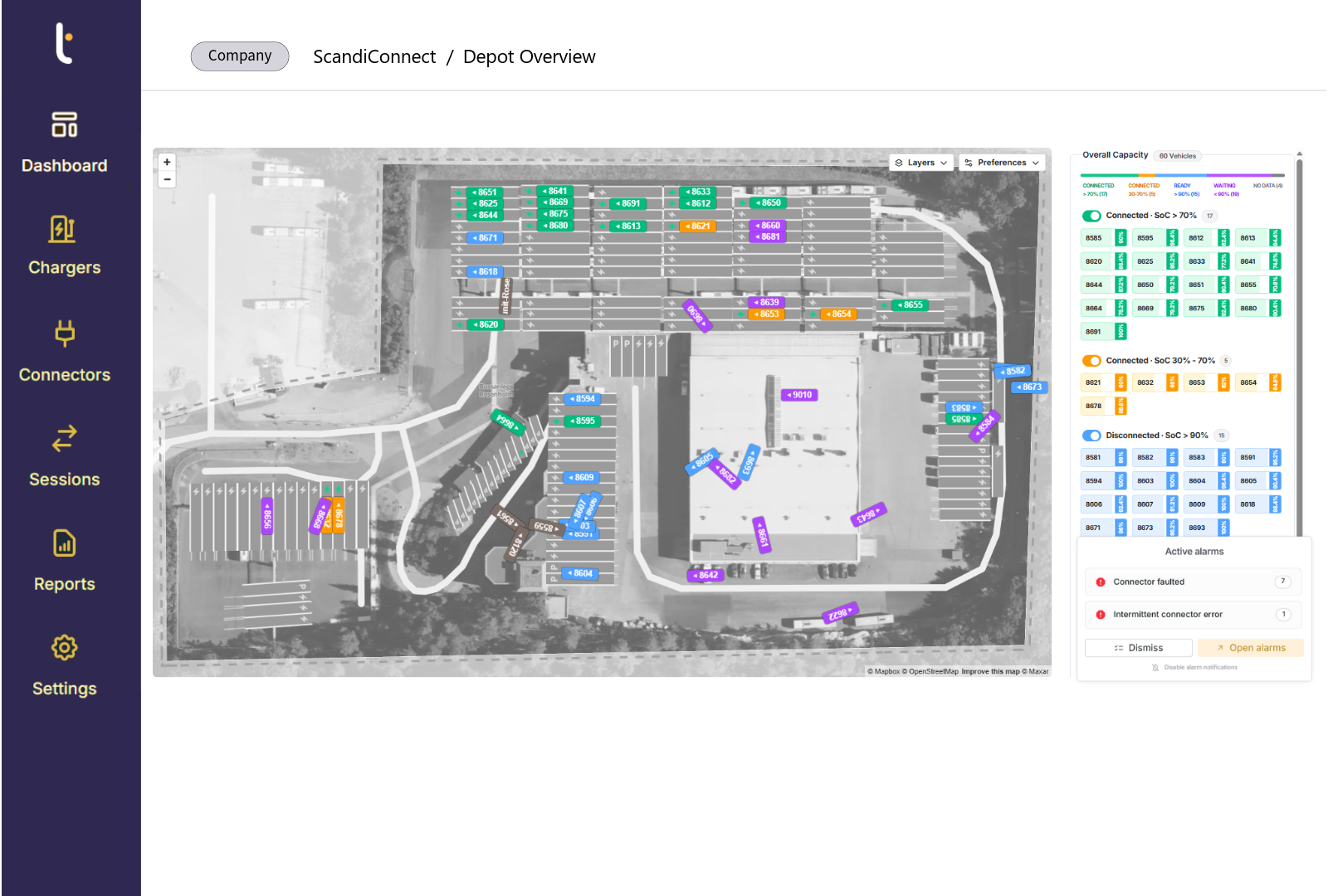
Se Tenix i aksjon
Be om en demo for å se hvordan Tenix støtter elbil-lading i stor skala – fra smart planlegging og laststyring til sanntidsdiagnostikk og koordinering av flere depoter.
Bestill demonstrasjonEller kontakt oss på sales@tenix.eu · +47 4777 0070
Utforsk
Videre lesning
Forklarer
7 grunner til at grunnleggende ladeprogramvare ikke er nok for elektriske bilflåter
Les mer English (UK)
  Norsk bokmål
  Français