
Scaling electric bus fleets works most reliably when bus groups standardise the charge operations platform, the data and the KPIs at group level, and leave charging strategy and depot set-up to local teams who know their grid, fleet and contracts. Start with one depot that already runs well, prove the results, then roll that set-up out depot by depot.
Tenix manages charging for more than 2,000 electric buses across 170 depots in six European countries, for operators running anything from a single depot to networks that span several countries. This article sets out what we have learned about scaling electric bus fleets from a handful of depots into a group-wide network.
Why does complexity grow when scaling electric bus fleets?
Each new depot brings its own grid contract, charger hardware, vehicle mix and local practices. More buses share the same power, and the pace is rising: electrically chargeable buses made up 23.8% of new EU bus registrations in 2025, according to ACEA.
Scaling electric bus fleets is an operational change programme as much as an investment in chargers and buses. The teams running it rarely have time to analyse data from every site and turn it into best practice. A shared platform and shared data give them that time back.
Where should a bus group start?
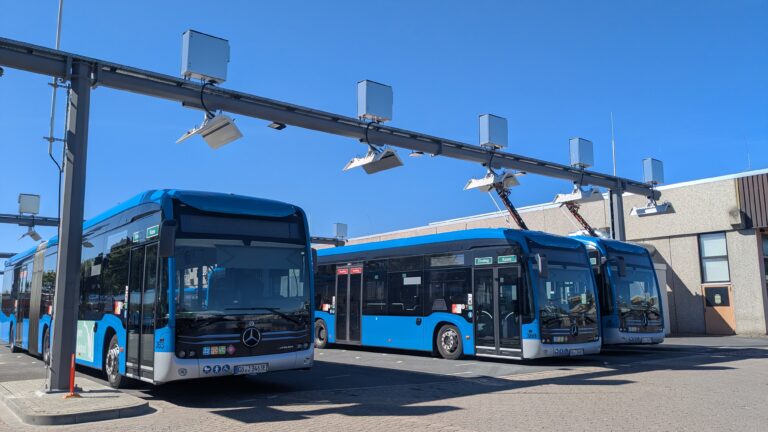
The pilot depot keeps operating as normal throughout, and every benefit comes on top of reliable charging. Charging plans always put departure readiness first, and Tenix Charge will ensure that no charging failure goes unalerted. The one thing to check early is whether any chargers lack OCPP support, since OCPP is the open protocol Tenix uses to control chargers.
What needs to be in place before rolling out across depots and countries?
Once the first depot has proved the approach, prepare the roll-out before the second depot connects:
- Define the KPIs and targets the group wants to reach.
- Agree a roll-out plan that sequences depots by the value they will gain.
- List every depot with its chargers and vehicles, so each one can be preconfigured in the system.
- Name a responsible person on site to authorise each connection. Charger and vehicle monitoring then starts from day one.
- Plan integrations with the scheduling systems used in each country.
- Train local trainers who can bring their own depot teams up to speed.
Results from the first depot are the strongest argument for the next one, so share them with each new site before it starts. A brand-independent platform handles a mix of charger and vehicle brands, so every depot can join with the hardware it already has. For how a single depot moves onto a new system, see Gå Live Med Et Nytt System For Lademannskap Om 24 Timer.
What should a group standardise, and what should stay local?
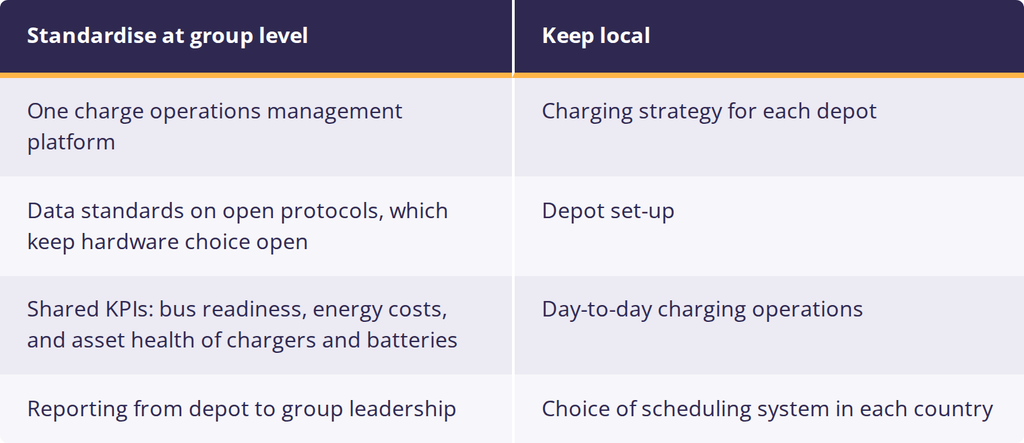
Grid limits, tariffs, fleet mix and contracts vary too much between depots for one charging strategy to fit them all. A shared platform still leaves room for that: one tender evaluation jury found that charge rules, priorities, target state of charge and planning can all be adjusted live, by bus group and by depot. Shared KPIs and reporting are what let the group consolidate data, set budgets, plan resources, spread best practice and keep control at headquarters.
How can leadership compare depots with different fleets, prices and grids?
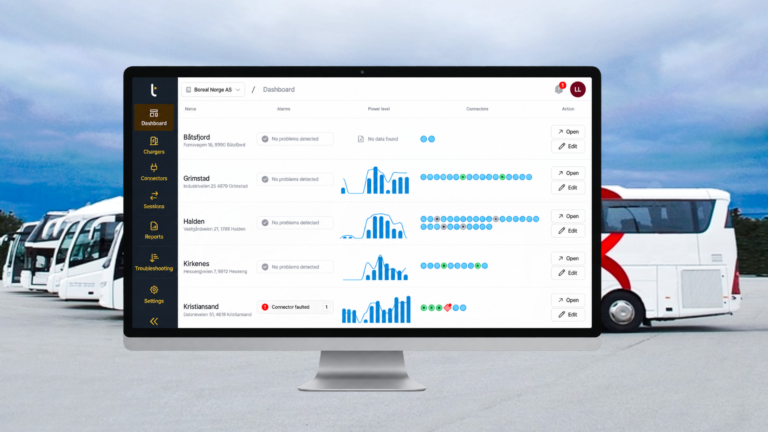
Set benchmark targets that account for local electricity prices and grid conditions, then measure every depot against them with the same data. One view of every charger and vehicle across the group shows which depots and countries perform best and which fall behind. Reporting needs to cut the data the same way everywhere, by depot, bus type and cost, so the comparison is fair. Leaders can then copy what works, add training where results lag and improve operating practice.
The comparison also reveals spare capacity. If one depot runs a similar-sized fleet on a much smaller grid connection, other depots may be able to operate within lower power limits too.
How do depots grow on the grid connections they already have?
Smart charging fits more buses on an existing connection. Load management keeps total demand within the power cap, while each bus charges to what its next duty needs across the charging window. When one tender evaluation jury tested this in a live demonstration, consumption stayed below the cap throughout, and showing the limit across several views “reinforced confidence in control of the global cap”.
That headroom lets depots keep adding buses while grid upgrades are planned, and deling av depot can turn spare charging capacity into revenue. Read more in Hva gjør vi når kapasiteten i strømnettet tar slutt?.
How does a common approach make a group more competitive in tenders?
A group running one platform can buy chargers and vehicles to common specifications, combine procurement and roll proven depot set-ups out to new sites. Each new contract starts from a set-up that already works, which keeps integration and training costs down.
Group-level data also strengthens bids and contract renewals with public transport authorities. Operators can show measured reliability and energy costs across many depots, and price new contracts with confidence.
Planning a roll-out across several depots or countries? Book a meeting with us and we will be happy to guide you further.
Ofte stilte spørsmål
Har du et annet spørsmål? Bare kontakt oss og spør.
What should a bus group standardize when scaling electric fleets?
The charge operations platform, data standards, KPIs and reporting. Charging strategy, depot set-up and daily charging operations stay with local teams.
Which depot should go first in an electric bus roll-out?
Choose a depot that already runs well. It carries the lowest risk, shows the clearest results and becomes the blueprint for the rest of the group.
Can we use different charger and vehicle brands across depots?
Yes. Tenix works with any charger or vehicle brand, providing one unified view of everything. Each depot can join with the hardware it already has.
What KPIs should a bus group track across depots?
Bus readiness, energy costs, and the asset health of chargers and batteries. Track them the same way at every depot, split by depot, bus type and cost. Leadership can then compare sites fairly, spot which depots lag, and copy what works from the best performers.
How do you compare charging costs in different countries?
Set benchmark targets that account for local electricity prices and grid conditions. Then measure every depot against them with the same data. One view of every charger and vehicle across the group shows which depots perform best, which fall behind, and where spare grid capacity exists.
Can smart charging add more electric buses without a grid upgrade?
Yes. Load management keeps total demand within the depot’s power cap, and each bus charges to what its next duty needs across the charging window. That headroom lets depots keep adding buses while grid upgrades are planned. Spare capacity can also be shared with other operators for revenue.



 English (UK)
  Norsk bokmål
  Français